
Section 8.5 Whitehead’s Theorem

HELP gives both existence and uniqueness of lifts up to homotopy: apply it to \(X\) to lift a map, and to \(X \times I\) to lift a homotopy. The latter requires one additional dimension.
For spaces \(X\) and \(Y\text{,}\) write \([X, Y]\) for the set of unbased homotopy classes of maps \(X \to Y\text{.}\)

Proof.

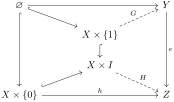
For surjectivity, apply HELP to the relative CW complex \((X,\varnothing)\text{.}\) Given \(h\colon X\to Z\text{,}\) the resulting diagram has the form
Here \(H_0=h\) and \(H_1=e\circ G\text{,}\) so \([h]=e_*[G]\text{.}\)
For injectivity, let \(g_0,g_1\colon X\to Y\) and let \(F\colon X\times I\to Z\) be a homotopy from \(e\circ g_0\) to \(e\circ g_1\text{.}\) Give \(X\times I\) the product CW structure. The pair \((X\times I,X\times\partial I)\) is relative, with relative cells of dimension at most \(\dim X+1\le n\text{.}\) On the boundary, let \(g\colon X\times\partial I\to Y\) restrict to \(g_0\) and \(g_1\) on the two ends, and let \(h\) be the constant homotopy from \(F|_{X\times\partial I}\) to \(e\circ g\text{:}\)
HELP gives \(G\colon X\times I\to Y\) extending \(g\text{.}\) Its restrictions to the two ends are \(g_0\) and \(g_1\text{,}\) so \(g_0\simeq g_1\text{.}\)
When both spaces are CW complexes, we can use this result to construct a homotopy inverse.

Proof.

By Theorem 8.10, \(e_* \colon [Z, Y] \to [Z, Z]\) is surjective, so there is \(g \colon Z \to Y\) with \(e \circ g \simeq \mathrm{id}_Z\text{.}\) Then \(e \circ (g \circ e) \simeq e = e \circ \mathrm{id}_Y\text{,}\) and injectivity of \(e_* \colon [Y, Y] \to [Y, Z]\) gives \(g \circ e \simeq \mathrm{id}_Y\text{.}\)

Remark 8.12.

The CW hypothesis on both spaces is essential, and the theorem does not say that two spaces with isomorphic homotopy groups are homotopy equivalent: the isomorphisms must be induced by a map. For instance \(S^2 \times \mathbb{RP}^3\) and \(S^3 \times \mathbb{RP}^2\) have isomorphic homotopy groups in every degree (both are covered by \(S^2 \times S^3\) with group \(\mathbb{Z}/2\)) but are not homotopy equivalent, as one is orientable and the other is not.

Proof.

The unique map \(X\to *\) is a weak homotopy equivalence, so Whitehead’s theorem gives a homotopy equivalence \(X\simeq *\text{.}\)

Exercise 8.14.

Let \(X_1\subseteq X_2\subseteq\cdots\) be an increasing sequence of subcomplexes of a CW complex, with \(X=\bigcup_i X_i\text{.}\) Suppose that every inclusion \(X_i\hookrightarrow X_{i+1}\) is null-homotopic. Use Whitehead’s theorem to show that \(X\) is contractible.

Exercise 8.15.

Let \(f\colon X\to Y\) be a weak homotopy equivalence. Suppose that \(X\) is a CW complex and that \(Y\) has the homotopy type of a CW complex. Show that \(f\) is a homotopy equivalence.

