
Section 7.1 CW Complexes

We first recall the gluing construction that we will use throughout. Given maps \(f \colon A \to B\) and \(g \colon A \to C\text{,}\) the pushout \(B \cup_A C\) is the quotient space
\begin{equation*} B \cup_A C = (B \sqcup C) \,/\, \bigl(f(a) \sim g(a) \text{ for all } a \in A\bigr). \end{equation*}
It comes with maps \(B \to B \cup_A C\) and \(C \to B \cup_A C\) making the evident square commute, and it is universal: a map out of \(B \cup_A C\) is the same thing as a pair of maps out of \(B\) and \(C\) that agree after composing with \(f\) and \(g\text{.}\) The case we care about is \(A = S^{n-1}\text{,}\) \(C = D^n\) and \(g\) the inclusion of the boundary sphere: for a map \(f \colon S^{n-1} \to B\text{,}\) the space \(B \cup_f D^n\) is “\(B\) with an \(n\)-cell attached along \(f\)”.

Definition 7.1.

A CW complex (or cell complex) is a space \(X\) equipped with a filtration
\begin{equation*} \varnothing =: X_{-1} \subseteq X_0 \subseteq \cdots \subseteq X_n \subseteq \cdots \subseteq X = \bigcup_{n=0}^{\infty} X_n, \end{equation*}
together with, for each \(n \geq 0\text{,}\) a set \(I_n\) and a collection of attaching maps \(f_\alpha \colon S^{n-1} \to X_{n-1}\) (\(\alpha \in I_n\)), such that the squares
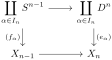
are pushouts. The maps \(e_\alpha \colon D^n \to X_n\) are called the characteristic maps, \(X_n\) is the \(n\)th skeleton, and \(X\) carries the weak topology: \(U \subseteq X\) is open if and only if \(U \cap X_n\) is open in \(X_n\) for all \(n\text{.}\)


Definition 7.2.

A CW complex \(X\) is finite dimensional if \(X = X_n\) for some \(n\text{,}\) of finite type if each \(I_n\) is finite, and finite if it is both. The dimension of \(X\) is the smallest \(n\) with \(X = X_n\text{,}\) if it exists.

Definition 7.3.

A subcomplex of a CW complex \(X\) is a closed subspace \(A \subseteq X\) that is a union of open cells of \(X\text{.}\) Equivalently, \(A\) is a union of cells such that for every cell \(e_\alpha \subseteq A\) the image \(f_\alpha(S^{n-1})\) of its attaching map also lies in \(A\text{.}\) A subcomplex is itself a CW complex, with skeleta \(A_n = A \cap X_n\text{,}\) and the pair \((X, A)\) is then called a CW pair. The skeleta \(X_n\) are subcomplexes of \(X\text{.}\)

Example 7.4.

The sphere \(S^n\) admits a minimal CW structure with a single \(0\)-cell and a single \(n\)-cell, via the pushout
The attaching map is the constant map to the \(0\)-cell, and the pushout is \(D^n / S^{n-1} \cong S^n\text{.}\)
Cell structures are not unique. One can also equip \(S^n\) with a CW structure having exactly two \(k\)-cells for each \(0 \leq k \leq n\text{:}\) start with \(S^0\) (two \(0\)-cells), and inductively obtain \(S^k\) from the equator \(S^{k-1}\) by attaching two \(k\)-cells, the upper and lower hemispheres, each along the identity map \(S^{k-1} \to S^{k-1} = X_{k-1}\text{.}\) In this structure the \(k\)-skeleton is \(S^k \subseteq S^n\text{.}\)

Example 7.5.

Real projective space \(\mathbb{R}P^n = S^n/\{\pm 1\}\) has a CW structure with exactly one cell in each dimension \(0 \leq k \leq n\text{.}\) To see this, note that every point of \(\mathbb{R}P^n\) has a representative in the closed upper hemisphere \(\{x_{n+1} \geq 0\} \cong D^n\text{,}\) uniquely except on the equator \(S^{n-1}\text{,}\) where \(x \sim -x\text{.}\) Hence
\begin{equation*} \mathbb{R}P^n \;\cong\; D^n / (x \sim -x \text{ for } x \in \partial D^n) \;=\; \mathbb{R}P^{n-1} \cup_q D^n, \end{equation*}
where \(q \colon S^{n-1} \to \mathbb{R}P^{n-1}\) is the two-fold covering map. Thus \(\mathbb{R}P^n\) is obtained from \(\mathbb{R}P^{n-1}\) by attaching a single \(n\)-cell, and by induction it has one cell in each dimension. This is the two-cells-per-dimension structure on \(S^n\) of Example 7.4, with the antipodal map identifying the two \(k\)-cells for each \(k\text{.}\) Passing to the union gives \(\mathbb{R}P^\infty = \bigcup_n \mathbb{R}P^n\text{,}\) an infinite-dimensional CW complex with one cell in each dimension.

Remark 7.6.

Not every space admits a CW structure, since CW complexes are locally contractible. For example, the rationals \(\mathbb{Q} \subseteq \mathbb{R}\) do not.

Definition 7.7.

A relative CW complex \((X, A)\) is a pair \(A \subseteq X\) where \(X\) has a filtration
\begin{equation*} A =: X_{-1} \subseteq X_0 \subseteq \cdots \subseteq X_n \subseteq \cdots \subseteq X = \bigcup_{n=-1}^{\infty} X_n, \end{equation*}
with pushout squares as in Definition 7.1 for each \(n \geq 0\text{,}\) and with \(X\) carrying the weak topology with respect to the \(X_n\text{.}\) That is, \(X\) is built from \(A\) by successively attaching cells, where now \(A\) is an arbitrary space. The cells of \(X_n \setminus X_{n-1}\) are the relative \(n\)-cells of \((X, A)\text{.}\)

Example 7.8.

A CW complex \(X\) is a relative CW complex \((X, \varnothing)\text{,}\) and a CW pair \((X, A)\) is a relative CW complex. If \(X\) is a CW complex, then \((X, X_n)\) and \((X_n, X_{n-k})\) are relative CW complexes for all \(0 \leq k \leq n\text{.}\) If \(f \colon S^{n-1} \to A\) is any map, then \((A \cup_f D^n, A)\) is a relative CW complex with a single relative \(n\)-cell.

Remark 7.9.

The utility of CW complexes lies in the following principle: whenever \((X, A)\) is a relative CW complex, one can establish properties of \(X\) by verifying them for discs and spheres and then deducing them for \(X\) by induction on the skeleta. The induction has three steps, corresponding to the three ways in which \(X\) is assembled from discs: disjoint unions, pushouts, and the colimit over the skeleta. We will see this pattern in the proof of Theorem 7.24 below, and again in Chapter 8, Chapter 9.
