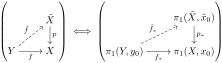
Recall the covering \(p \colon S^1 \to S^1\) given by \(z \mapsto z^n\text{,}\) for \(n \geq 1\text{.}\) Let \(\gamma \colon I \to S^1\text{,}\) \(\gamma(t) = e^{2\pi i t}\text{,}\) be a generator of the fundamental group upstairs, and write \(\omega\) for the same map thought of as generating the fundamental group downstairs. Then
\begin{equation*}
(p \circ \gamma)(t) = e^{2\pi i n t},
\end{equation*}
so \(p_*[\gamma] = [\omega]^n\) by Remark 2.17. Under the isomorphism \(\pi_1(S^1, 1) \cong \mathbb{Z}\) of Theorem 2.16 this says
\begin{equation*}
p_*\,\pi_1(S^1, 1) = n\mathbb{Z} \subseteq \mathbb{Z}.
\end{equation*}
Varying \(n\text{,}\) and taking the covering \(\mathbb{R} \to S^1\) of Theorem 2.16 for the trivial subgroup, we realise every subgroup of \(\pi_1(S^1, 1)\) as the image of \(p_*\) for some covering of \(S^1\text{.}\) This is no accident: see Proposition 3.17.