
Section 5.1 Definition

Recall that a pair of spaces \((X, A)\) consists of a space \(X\) together with a subspace \(A \subseteq X\text{.}\) A map of pairs \(f \colon (X, A) \to (Y, B)\) is a continuous map \(f \colon X \to Y\) with \(f(A) \subseteq B\text{.}\) A homotopy of pairs is a homotopy \(H \colon X \times I \to Y\) with \(H(A \times I) \subseteq B\text{.}\) This forms an equivalence relation on maps of pairs \((X,A) \to (Y,B)\text{.}\)

Definition 5.1.

Let \(x_0 \in X\text{.}\) The \(n\)th homotopy group \(\pi_n(X, x_0)\) is the quotient
\begin{equation*} \pi_n(X, x_0) \;=\; \bigl\{\, f \colon (I^n, \partial I^n) \to (X, x_0) \,\bigr\} \,\big/\, \text{homotopies of pairs}. \end{equation*}
Example 5.2.

If \(n = 1\text{,}\) then \(\partial I = \{0, 1\}\text{,}\) and a homotopy of pairs \(H \colon (I, \partial I) \times I \to (X, x_0)\) is precisely a path-homotopy: \(H(0, t) = x_0\) and \(H(1, t) = x_0\text{.}\) Thus \(\pi_1(X, x_0)\) is the usual fundamental group.
If \(n = 0\text{,}\) then \(I^0 = \{*\}\) and \(\partial I^0 = \emptyset\text{,}\) so \(\pi_0(X, x_0)\) is the set of path components of \(X\) (independent of \(x_0\)).

Proof.

The verification that \(+\) defines a group operation follows the same arguments as for the fundamental group. To prove that \(\pi_n(X, x_0)\) is abelian for \(n \geq 2\text{,}\) use the following two exercises.

Exercise 5.4. Eckmann–Hilton argument.

Let \(M\) be a set, and let \(\ast,\bullet\) be two binary operations on \(M\text{,}\) \(\ast,\bullet \colon M \times M \to M\) with unit elements. Suppose that
\begin{equation*} (a \ast b) \bullet (c \ast d) = (a \bullet c) \ast (b \bullet d) \end{equation*}
for all \(a,b,c,d \in M\text{.}\) Then, the units agree, the two operations agree, and they are commutative and associative.

Exercise 5.5.

Suppose we define an alternate sum \(f +' g\) on \(\pi_n(X,x_0)\) which uses some other coordinate (not the first). Verify that
\begin{equation*} (f + g) +' (h + k) = (f +' h) + (g +' k), \end{equation*}
so that the precious exercise shows that \(+ = +'\) and that \(+\) is abelian.

Remark 5.6.

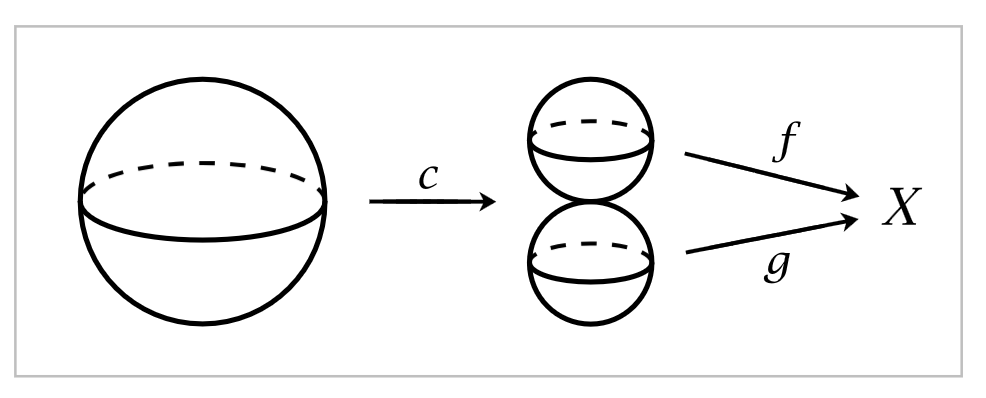
We can also realise \(\pi_n(X, x_0)\) as homotopy classes of based maps \(f \colon (S^n, s_0) \to (X, x_0)\text{.}\) Under this identification the sum \([f] + [g]\) is visualised by pinching the equator of \(S^n\) to a point, giving \(c \colon S^n \to S^n \vee S^n\text{,}\) followed by \(f \vee g \colon S^n \vee S^n \to X\text{:}\)
image

Exercise 5.7.

Let \(G\) be a connected topological group with identify element \(e\text{.}\) Show, using an Eckmann-Hilton argument, that \(\pi_1(G,e)\) is abelian.

