Let \(B\) be a simply connected pointed space. The path space fibration
\begin{equation*}
\Omega B \;\longrightarrow\; PB \;\xrightarrow{\;\mathrm{ev}_1\;}\; B
\end{equation*}
has total space the contractible path space \(PB \simeq *\text{,}\) so \(H_n(PB) = \mathbb{Z}\) for \(n = 0\) and \(0\) otherwise. The Serre spectral sequence of this fibration is
\begin{equation*}
E^2_{p,q} \;=\; H_p\bigl(B;\, H_q(\Omega B)\bigr) \;\Longrightarrow\; H_{p+q}(PB) \;\cong\; \begin{cases} \mathbb{Z} & p+q = 0, \\ 0 & p+q \neq 0. \end{cases}
\end{equation*}
Pictorially the \(E^2\) page in the relevant range looks like:
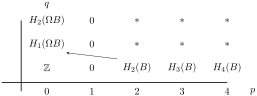
The bottom row \(E^2_{p,0} = H_p(B; H_0(\Omega B)) = H_p(B)\) uses that \(\Omega B\) is path-connected, and the leftmost column \(E^2_{0,q} = H_0(B; H_q(\Omega B)) = H_q(\Omega B)\) uses that \(B\) is path-connected. The zero in position \((1, 0)\) is \(H_1(B) = 0\text{,}\) since \(B\) is simply connected.
The diagonal \(p + q = 1\) must vanish on the \(E^\infty\) page, since the abutment is concentrated on the diagonal \(p + q = 0\text{.}\) The only nonzero entry on \(p + q = 1\) at \(E^2\) is \(E^2_{0,1} = H_1(\Omega B)\text{,}\) and the only differential that can hit it is
\begin{equation*}
d^2 \colon E^2_{2,0} \;=\; H_2(B) \;\longrightarrow\; E^2_{0,1} \;=\; H_1(\Omega B).
\end{equation*}
For this to leave \(0\) at \(E^\infty\) on both sides of the differential, \(d^2\) must be an isomorphism. We conclude:
\begin{equation*}
H_1(\Omega B) \;\cong\; H_2(B).
\end{equation*}
This is a baby version of the kind of differential-finding argument that drives essentially every Serre spectral sequence computation.