
Section 15.1 Representable Functors

Definition 15.1.

Let \(\mathcal{C}\) be a category. A functor \(F \colon \mathcal{C}^{\mathrm{op}} \to \mathbf{Set}\) is representable if there exist an object \(X \in \mathcal{C}\) and a natural isomorphism
\begin{equation*} \varphi \colon \mathrm{Hom}_{\mathcal{C}}(-, X) \;\xrightarrow{\;\cong\;}\; F. \end{equation*}
That is, for each \(y \in \mathcal{C}\) a bijection \(\varphi_y \colon \mathrm{Hom}_{\mathcal{C}}(y, X) \to F(y)\) such that, for every morphism \(f \colon z \to y\text{,}\) the square
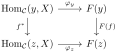
commutes. (A covariant functor \(F \colon \mathcal{C} \to \mathbf{Set}\) admitting \(\mathrm{Hom}_{\mathcal{C}}(X, -) \cong F\) is sometimes called corepresentable.)


Remark 15.2.

A representable functor always has a distinguished generic element \(\alpha = \varphi_X(\mathrm{id}_X) \in F(X)\text{.}\) Every element \(\beta \in F(y)\) arises as \(\beta = f^*(\alpha)\) for a unique \(f \colon y \to X\text{,}\) namely \(f = \varphi_y^{-1}(\beta)\text{.}\)

Example 15.3. Open-set functor.

The functor \(\mathcal{T} \colon \mathbf{Top}^{\mathrm{op}} \to \mathbf{Set}\) sending \(Y\) to its set of open subsets is representable. Take \(X = \{0, 1\}\) with the Sierpinski topology \(\{\varnothing, \{1\}, \{0, 1\}\}\) and define
\begin{equation*} \varphi_Y \colon \mathrm{Hom}_{\mathbf{Top}}(Y, \{0,1\}) \to \mathcal{T}(Y), \qquad f \mapsto f^{-1}(\{1\}). \end{equation*}
The inverse sends an open set \(U \subseteq Y\) to its characteristic function \(\chi_U\text{.}\) The generic element is \(\{1\} \in \mathcal{T}(\{0,1\})\text{.}\)

Example 15.4. Cohomology.

For an abelian group \(G\) and \(n \geq 1\text{,}\) Theorem 14.9 says that the functor \(H^n(-; G) \colon \mathrm{Ho}(\mathbf{CW})^{\mathrm{op}} \to \mathbf{Set}\) is representable by \(K(G, n)\text{,}\) with generic element the fundamental class \(\iota \in H^n(K(G, n); G)\text{.}\)
A representing space turns the problem of describing cohomology classes into the problem of describing homotopy classes of maps. We first ask what properties such a description forces on a functor.