Proof of Theorem 8.6. We induct over the relative skeleta. Write
\begin{equation*}
A=X_{-1}\subseteq X_0\subseteq X_1\subseteq\cdots\subseteq X,
\qquad X=\bigcup_n X_n,
\end{equation*}
where \(X_n\) is obtained from \(X_{n-1}\) by attaching the relative \(n\)-cells. Suppose that maps \(G_{n-1}\colon X_{n-1}\to Y\) and \(H_{n-1}\colon X_{n-1}\times I\to Z\) have already been constructed, extending the given data on \(A\text{.}\) For \(n=0\text{,}\) extend over each new point using the surjectivity of \(\pi_0(Y)\to\pi_0(Z)\text{;}\) assume \(n\geq1\) below.
For each
\(n\)-cell, with characteristic map
\(\Phi\colon D^n\to X_n\) and attaching map
\(\varphi\colon S^{n-1}\to X_{n-1}\text{,}\) apply
Lemma 8.8 to the data
\begin{equation*}
f\circ\Phi,\qquad G_{n-1}\circ\varphi,\qquad
H_{n-1}\circ(\varphi\times\mathrm{id}_I).
\end{equation*}
The resulting maps on \(D^n\) and \(D^n\times I\) agree with the old maps on the attaching sphere, so they glue over all the \(n\)-cells to give \(G_n\) and \(H_n\) on \(X_n\text{.}\)
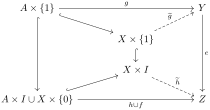
The inductive step can be summarized by the following diagram. The maps
\(G_{n-1}\) and
\(H_{n-1}\) have already been constructed on the previous stage; the disc lemma supplies the dashed extensions
\(G_n\) and
\(H_n\text{:}\)
The bottom map is
\(H_{n-1}\) on
\(X_{n-1}\times I\) and
\(f\) on
\(X_n\times\{0\}\text{;}\) these agree on
\(X_{n-1}\times\{0\}\text{.}\)
The compatible maps
\(G_n\) and
\(H_n\) assemble into
\(\widetilde g\colon X\to Y\) and
\(\widetilde h\colon X\times I\to Z\text{.}\) They are continuous by the weak topology, also on the cylinder since
\(I\) is compact. Their restrictions give all the required endpoint and extension conditions.