Let
\(CA = (A \times I)/(A \times \{1\})\) be the cone on
\(A\) (
Exercise 7.15), with
\(A\) included as
\(a \mapsto [(a,0)]\text{,}\) and form the CW complex
\(Y = X \cup_A CA\text{.}\) The cone
\(CA\) is a contractible subcomplex of
\(Y\text{,}\) so the quotient map
\(q \colon Y \to Y/CA = X/A\) is a homotopy equivalence (
Proposition 7.17). The quotient map also defines a map of pairs
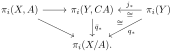
\(\bar q \colon (Y, CA) \to (X/A, *)\text{,}\) and we get a commutative diagram
The left triangle commutes because the composite
\((X, A) \to (Y, CA) \xrightarrow{\bar q} (X/A, *)\) is the quotient map of
\((X, A)\text{.}\) The right triangle commutes because the composite
\((Y, *) \to (Y, CA) \xrightarrow{\bar q} (X/A, *)\) is
\(q\text{.}\) The map
\(j_*\) is an isomorphism by the long exact sequence of
\((Y, CA)\text{,}\) since
\(CA\) is contractible. Hence
\(\bar q_*\) is an isomorphism, and it suffices to study the map
\(\pi_i(X, A) \to \pi_i(Y, CA)\text{.}\)
We apply
Theorem 11.6 to the CW triad
\((Y; X, CA)\text{,}\) whose intersection is
\(X \cap CA = A\text{.}\) The pair
\((X, A)\) is
\(r\)-connected by hypothesis, and
\((CA, A)\) is
\((s+1)\)-connected. Indeed, the cone
\(CA\) is contractible, so the long exact sequence gives
\(\pi_i(CA, A) \cong \pi_{i-1}(A)\text{,}\) which vanishes for
\(i \leq s+1\) because
\(A\) is
\(s\)-connected. Excision then gives that
\(\pi_i(X, A) \to \pi_i(Y, CA)\) is an isomorphism for
\(i < r + s + 1\) and a surjection for
\(i = r + s + 1\text{.}\)