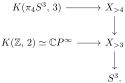
Consider the Whitehead tower of
\(X = S^3\text{.}\) Since
\(S^3\) is
\(2\)-connected,
\(X = X_{>1} = X_{>2}\text{.}\) The next two layers fit into fibrations
Recall from
Chapter 21 that
\(\pi_4(S^3) \cong \mathbb{Z}/2\text{,}\) so the top fibre is
\(K(\mathbb{Z}/2, 3)\text{.}\) Since
\(X_{>4}\) is
\(4\)-connected, Hurewicz gives
\begin{equation*}
H_5(X_{>4}) \;\cong\; \pi_5(X_{>4}) \;\cong\; \pi_5(S^3).
\end{equation*}
Step 1: cohomology of \(X_{>3}\text{.}\) The fibration \(\mathbb{C}P^\infty \to X_{>3} \to S^3\) has the cohomological Serre spectral sequence
\begin{equation*}
E_2^{p,q} \;\cong\; H^p(S^3; \mathbb{Z}) \otimes H^q(\mathbb{C}P^\infty; \mathbb{Z}),
\end{equation*}
concentrated in the two columns \(p = 0, 3\) tensored with \(\mathbb{Z}[u]\text{,}\) \(|u| = 2\text{.}\) The only possibly nonzero differential is \(d_3\text{.}\) Since \(X_{>3}\) is \(3\)-connected, \(H^2(X_{>3}) = H^3(X_{>3}) = 0\text{,}\) so the diagonals \(p+q = 2, 3\) at \(E_\infty\) must vanish. This forces
\begin{equation*}
d_3 \colon E_3^{0,2} = \mathbb{Z}\{u\} \;\xrightarrow{\;\cong\;}\; E_3^{3,0} = \mathbb{Z}.
\end{equation*}
Multiplicativity then gives \(d_3(u^n) = n\, u^{n-1} \cdot d_3(u)\text{,}\) so \(d_3 \colon E_3^{0, 2n} \to E_3^{3, 2n-2}\) is multiplication by \(n\text{.}\) We read off:
\begin{equation*}
E_\infty^{0, 2n} = 0, \qquad E_\infty^{3, 2n-2} = \mathbb{Z}/n.
\end{equation*}
Tabulating:
\begin{equation*}
\renewcommand{\arraystretch}{1.2}
\begin{array}{c|cccccccc}
q & 0 & 1 & 2 & 3 & 4 & 5 & 6 & 7 \\ \hline
H^q(X_{>3}; \mathbb{Z}) & \mathbb{Z} & 0 & 0 & 0 & 0 & \mathbb{Z}/2 & 0 & \mathbb{Z}/3
\end{array}
\end{equation*}
and similarly \(H^{2k+1}(X_{>3}) = \mathbb{Z}/k\) for \(k \geq 1\text{.}\) By UCT, \(H_q(X_{>3}) = \mathbb{Z}/k\) for \(q = 2k\) (\(k \geq 1\)) and \(0\) otherwise (when \(q > 0\)).
Step 2: \(H_5(X_{>4})\) via the next layer. Run the homological Serre spectral sequence for \(K(\mathbb{Z}/2,\, 3) \to X_{>4} \to X_{>3}\text{:}\)
\begin{equation*}
E^2_{p,q} \;=\; H_p\bigl(X_{>3};\, H_q(K(\mathbb{Z}/2, 3); \mathbb{Z})\bigr) \;\Longrightarrow\; H_{p+q}(X_{>4}).
\end{equation*}
The integral homology of
\(K(\mathbb{Z}/2, 3)\) in low degrees is a separate Serre computation (analogous to
Chapter 21 but with
\(\mathbb{Z}/2\) in place of
\(\mathbb{Z}\)); it gives
\begin{equation*}
H_q(K(\mathbb{Z}/2, 3); \mathbb{Z}) \;=\; \mathbb{Z}/2 \text{ for } q = 3, 5, \quad 0 \text{ for } q = 1, 2, 4.
\end{equation*}
The relevant region of the \(E^2\) page:
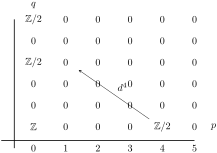
Since \(X_{>4}\) is \(4\)-connected, the diagonals \(p+q = 1, 2, 3, 4\) at \(E^\infty\) all vanish. On \(p + q = 3\) the only off-origin \(E^2\) entry is \(E^2_{0,3} = \mathbb{Z}/2\text{;}\) the only way to kill it is for
\begin{equation*}
d^4 \colon E^4_{4,0} = \mathbb{Z}/2 \;\xrightarrow{\;\cong\;}\; E^4_{0,3} = \mathbb{Z}/2
\end{equation*}
to be an isomorphism. This also kills \(E^2_{4,0}\text{,}\) confirming \(H_4(X_{>4}) = 0\text{.}\)
On \(p + q = 5\text{,}\) the only off-origin \(E^2\) entry is \(E^2_{0,5} = \mathbb{Z}/2\text{.}\) The only differential that could hit it is
\begin{equation*}
d^6 \colon E^6_{6,0} \;\to\; E^6_{0,5} = \mathbb{Z}/2.
\end{equation*}
But \(H_6(X_{>3}) = \mathbb{Z}/3\text{,}\) so \(E^6_{6,0}\) is a subquotient of \(\mathbb{Z}/3\text{.}\) The only group homomorphism \(\mathbb{Z}/3 \to \mathbb{Z}/2\) is the zero map, so this differential vanishes. Hence \(E^\infty_{0,5} = \mathbb{Z}/2\text{,}\) and the \(E^\infty\) filtration on \(H_5(X_{>4})\) has only this one nonzero quotient. We conclude
\begin{equation*}
\pi_5(S^3) \;\cong\; H_5(X_{>4}) \;\cong\; \mathbb{Z}/2.
\end{equation*}