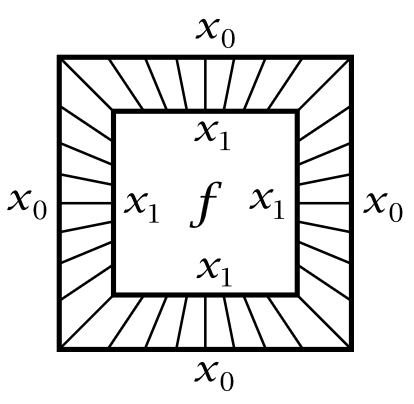
If \(X\) is path-connected, \(\pi_n(X, x_0)\) does not depend on the basepoint \(x_0\text{.}\) Let \(\gamma \colon I \to X\) be a path from \(x_0\) to \(x_1\text{.}\) We construct a map
as follows: shrink the domain of \(f\) to a smaller cube inside \(I^n\) and insert the path \(\gamma\) radially on the boundary of the cube. The resulting map \(\gamma \cdot f\) agrees with \(f\) on the small inner cube and with \(\gamma\) along the radial directions, sending \(\partial I^n\) to \(x_0\text{.}\)
Property (1) tells us that \(\beta_\gamma\) is a group homomorphism. Properties (2) and (3) tell us that \(\beta_\gamma\) is an isomorphism, with inverse \(\beta_{\bar\gamma}\text{,}\) where \(\bar\gamma\) is the reverse path.