
Section 9.1 Cellular approximation

Throughout, \(X_n\) denotes the \(n\)-skeleton of a CW complex \(X\text{.}\)

Definition 9.1.

Let \(X\) and \(Y\) be CW complexes. A map \(f \colon X \to Y\) is cellular if \(f(X_n) \subseteq Y_n\) for all \(n \geq 0\text{.}\) A cellular approximation of a map \(f \colon X \to Y\) is a cellular map \(f' \colon X \to Y\) together with a homotopy \(f \simeq f'\text{.}\)
Our goal is to show that these always exist. We start with the following.

Proof.

By compactness and the weak topology of a relative CW complex, the image of a disc lies in \(Y\) together with a finite relative subcomplex. Removing its relative cells in decreasing order of dimension therefore reduces the proof to the case where \(Z=Y\cup_\alpha D^r\) for \(\alpha\colon S^{r-1}\to Y\text{,}\) \(r\geq n+1\text{.}\) An element of \(\pi_k(Z,Y)\) is represented by a map of pairs \(g\colon(D^k,S^{k-1})\to(Z,Y)\text{.}\) By smooth or simplicial approximation
 1 
inside the open cell, we can find a map \(g'\colon D^k\to Z\text{,}\) homotopic to \(g\) relative to \(S^{k-1}\text{,}\) that misses a point \(p\) in the interior of \(D^r\text{,}\) since \(k<r\text{.}\) Radial projection deforms \(Z\setminus\{p\}\) onto \(Y\text{,}\) fixing \(Y\text{,}\) and so deforms \(g'\) to a map into \(Y\text{.}\) Thus \([g]=0\text{.}\)

Proof.

All cells of \(X\) outside \(X_n\) have dimension \(>n\text{,}\) so Lemma 9.2 gives that \((X,X_n)\) is \(n\)-connected. The long exact sequence of the pair identifies this with the \(n\)-equivalence condition, as explained after Definition 8.2.
Thus \(\pi_i(X)\) is determined by the \((i+1)\)-skeleton: attaching cells of dimension \(\geq i + 2\) leaves \(\pi_i\) unchanged, while attaching cells of dimension \(i + 1\) induces a surjection on \(\pi_i\text{.}\) For instance \(\pi_1(X) \cong \pi_1(X_2)\text{,}\) i.e., the fundamental group is determined by the \(2\)-skeleton, just as a group presentation needs only generators (\(1\)-cells) and relations (\(2\)-cells).

Example 9.4. The torus and its skeleta.

The usual CW structure on \(T^2\) has one vertex, two \(1\)-cells \(a,b\text{,}\) and one \(2\)-cell attached along \(aba^{-1}b^{-1}\text{.}\) Thus
\begin{equation*} \pi_1((T^2)_1)=F(a,b)\longrightarrow\pi_1(T^2)=\mathbb Z^2 \end{equation*}
is surjective but not injective: the \(2\)-cell kills the commutator.

Proof.

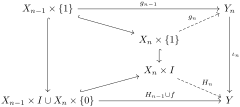
First take \(A=\varnothing\text{.}\) We construct the approximation inductively over the skeleta, starting with \(n=0\text{.}\) Since \(Y_0\hookrightarrow Y\) is surjective on path components, for each point \(x\in X_0\) we can choose a point \(g_0(x)\in Y_0\) and a path from \(f(x)\) to \(g_0(x)\text{.}\) As \(X_0\) is discrete, these choices define a continuous map \(g_0\colon X_0\to Y_0\) and a homotopy \(H_0\colon X_0\times I\to Y\) from \(f|_{X_0}\) to \(g_0\text{.}\) This starts the induction.
Now let \(n\geq1\text{.}\) Suppose that a map \(g_{n-1}\colon X_{n-1}\to Y_{n-1}\) has been constructed, together with a homotopy \(H_{n-1}\) from \(f|_{X_{n-1}}\) to \(g_{n-1}\) viewed as a map into \(Y\text{.}\) We check the hypotheses of HELP (Theorem 8.6):
  • The pair \((X_n,X_{n-1})\) is a relative CW complex whose relative cells are precisely the \(n\)-cells of \(X\text{,}\) so they have dimension \(\leq n\text{.}\)
  • The map \(e=\iota_n\colon Y_n\hookrightarrow Y\) is an \(n\)-equivalence by Corollary 9.3.
  • The given map is \(f|_{X_n}\colon X_n\to Y\text{.}\) The boundary lift is \(g_{n-1}\colon X_{n-1}\to Y_{n-1}\hookrightarrow Y_n\text{,}\) and the boundary homotopy is \(H_{n-1}\text{.}\) By induction their endpoints satisfy
    \begin{equation*} H_{n-1}(-,0)=f|_{X_{n-1}},\qquad H_{n-1}(-,1)=\iota_n\circ g_{n-1}. \end{equation*}
Thus all the hypotheses hold, and HELP gives the dashed maps in
Thus \(g_n\) lands in \(Y_n\text{,}\) extends \(g_{n-1}\text{,}\) and \(H_n\) extends \(H_{n-1}\text{.}\) Taking unions gives a cellular map \(f'\) and a homotopy \(f\simeq f'\text{;}\) the weak topology gives continuity, also for the homotopy since \(I\) is a finite CW complex.
For the relative version, at stage \(n\) apply HELP to \((X_n,X_{n-1}\cup(A\cap X_n))\text{.}\) Its relative cells are exactly the \(n\)-cells of \(X\) not in \(A\text{,}\) so the same dimension bound holds. On \(A\cap X_n\) prescribe \(f\) and the constant homotopy; this map lands in \(Y_n\) because \(f|_A\) is cellular. The prescribed data agree on the intersection by induction. Thus every stage fixes \(A\cap X_n\text{,}\) and the assembled homotopy fixes all of \(A\text{.}\)
Proof.

Let \(f \colon (S^k, s_0) \to (S^n, s_0)\) be based, where \(s_0\) is the \(0\)-cell in the minimal CW structures. Then \(f\) is cellular on the subcomplex \(\{s_0\}\text{,}\) so by Theorem 9.5 it is homotopic rel \(s_0\) to a cellular map \(f'\text{.}\) Cellularity gives \(f'(S^k) = f'((S^k)_k) \subseteq (S^n)_k = \{s_0\}\text{,}\) so \(f'\) is constant and \([f] = [f'] = 0\text{.}\)

Example 9.7.

Give \(S^\infty = \bigcup_n S^n\) the CW structure with two cells in each dimension, so that \((S^\infty)_n = S^n\text{.}\) By Corollary 9.3 and Corollary 9.6, \(\pi_i(S^\infty) \cong \pi_i(S^{i+1}) = 0\) for all \(i \geq 0\text{.}\) So \(S^\infty \to *\) is a weak equivalence, and by Whitehead’s Theorem \(S^\infty\) is contractible.

Remark 9.8.

A map of CW pairs \(f\colon(X,A)\to(Y,B)\) is cellular if its underlying map \(X\to Y\) is cellular: since \(A_n=A\cap X_n\) and \(B_n=B\cap Y_n\text{,}\) its restriction \(A\to B\) is then automatically cellular as well. However, applying cellular approximation directly to \(f\colon X\to Y\) need not keep \(A\) inside \(B\) during the homotopy, or even at its endpoint. The relative clause fixes \(A\) only when \(f|_A\) is already cellular. To obtain a homotopy through maps of pairs, we therefore first make \(f|_A\) cellular within \(B\text{,}\) extend this homotopy over \(X\) using HEP, and then approximate the resulting map relative to \(A\text{.}\)

Proof.

Apply Theorem 9.5 to \(f|_A \colon A \to B\) to get a cellular map \(g \colon A \to B\) and a homotopy \(H \colon f|_A \simeq g\text{.}\) Composing with \(B \hookrightarrow Y\) and using the HEP for \((X, A)\text{,}\) extend \(H\) to a homotopy from \(f\) to a map \(f' \colon X \to Y\) with \(f'|_A = g\text{.}\) Now apply Theorem 9.5 to \(f'\text{,}\) with \(A\) as the subcomplex on which \(f'\) is already cellular, to obtain a cellular \(f'' \simeq f'\) rel \(A\text{.}\) Both homotopies keep \(A\) inside \(B\text{,}\) so the composite is a homotopy of pairs.
For CW pairs, cellular approximation also recovers the connectivity statement from Lemma 9.2, though not independently: that lemma was used to prove cellular approximation.

Proof.

Let \(1\leq i\leq n\) and represent a class by a based map of pairs \(f\colon(D^i,S^{i-1})\to(X,A)\text{.}\) First choose the basepoint in \(A\) to be a vertex. By cellular approximation for pairs (Corollary 9.9), keeping the basepoint fixed in both steps of its proof, \(f\) is homotopic through based maps of pairs to a cellular map \(g\text{.}\) Then \(g(D^i)\subseteq X_i\subseteq A\text{,}\) so the compression criterion (Proposition 6.13) gives \([f]=[g]=0\text{.}\) Change of basepoint in \(A\) handles arbitrary basepoints. For \(i=0\text{,}\) every component of \(X\) meets \(X_0\subseteq A\text{.}\)

Proof.

Exercise 9.12.

Show that homotopic cellular maps \(f_0, f_1 \colon X \to Y\) are cellularly homotopic, i.e., there is a homotopy \(H \colon X \times I \to Y\) between them which is a cellular map for the product CW structure on \(X \times I\text{.}\)

Exercise 9.13.

Let \(X\) and \(Y\) be homotopy equivalent CW complexes, neither of which has cells of dimension \(n+1\text{.}\) Use cellular approximation and Exercise 9.12 to show that their \(n\)-skeleta \(X_n\) and \(Y_n\) are homotopy equivalent.

