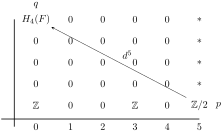
Pick a map \(f \colon S^3 \to K(\mathbb{Z}, 3)\) generating \(\pi_3(K(\mathbb{Z}, 3)) \cong \mathbb{Z}\text{,}\) and convert it into a fibration \(p \colon E_f \to K(\mathbb{Z}, 3)\) with \(S^3 \xrightarrow{\simeq} E_f\) a weak equivalence. Let \(F\) be the fibre. The long exact sequence in homotopy of \(F \to E_f \to K(\mathbb{Z}, 3)\) shows:
Since \(F\) is \(3\)-connected, \(H_0(F) = \mathbb{Z}\) and \(H_1(F) = H_2(F) = H_3(F) = 0\text{.}\) So the bottom row of \(E^2\) is the table of \(H_*(K(\mathbb{Z}, 3))\) above, and rows \(q = 1, 2, 3\) vanish.
The diagonal \(p + q = 4\) at \(E^2\) contains only the entry \(E^2_{0,4} = H_4(F)\text{.}\) For the abutment \(H_4(S^3) = 0\text{,}\) every entry on this diagonal must die. Differentials out of\(E^r_{0,4}\) all vanish, since their targets \((-r,\, 3+r)\) lie outside the first quadrant; so the only possibly nonzero differential into\(E^r_{0,4}\) is \(d^5 \colon E^5_{5,0} \to E^5_{0,4}\text{.}\) From the homology table, \(E^2_{5,0} = H_5(K(\mathbb{Z}, 3)) = \mathbb{Z}/2\text{.}\) Tracking what survives to \(E^5\) in position \((5, 0)\) requires checking that earlier differentials \(d^r\) for \(r < 5\) do not change it: incoming \(d^r\) at \((5, 0)\) originates at \((5+r, 1-r)\) which is in a zero row for \(r \geq 2\text{;}\) outgoing \(d^r\) at \((5, 0)\) lands at \((5-r, r-1)\) which is in a zero row for \(r = 2, 3, 4\text{.}\) So \(E^5_{5,0} = \mathbb{Z}/2\) unchanged.