Theorem 22.1. Postnikov sections.
Let
\(X\) be a connected CW complex and
\(n \geq 1\text{.}\) There exists a CW complex
\(X_{\leq n}\) containing
\(X\) as a subcomplex such that
-
\(\pi_i(X_{\leq n}) = 0\) for \(i > n\text{;}\)
-
the inclusion \(X \hookrightarrow X_{\leq n}\) induces an isomorphism on \(\pi_i\) for \(i \leq n\text{.}\)
The construction is by repeatedly attaching cells: for each generator of
\(\pi_{n+1}(X)\text{,}\) attach an
\((n+2)\)-cell to kill it; this may introduce new
\(\pi_{n+2}\)-elements, which are killed by attaching
\((n+3)\)-cells; and so on. The same technique was used in the construction of Eilenberg–MacLane spaces (
Chapter 13). The space
\(X_{\leq n}\) is called the
\(n\)th Postnikov section of
\(X\text{,}\) and is unique up to weak equivalence.
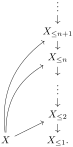
The inclusion
\(X \hookrightarrow X_{\leq n}\) extends to a map
\(X_{\leq n+1} \to X_{\leq n}\) (since
\(X_{\leq n+1}\) is obtained from
\(X\) by attaching cells of dimension
\(\geq n + 3\text{,}\) all of which can be filled in
\(X_{\leq n}\) where
\(\pi_i = 0\) for
\(i > n\)). This yields the
Postnikov tower of
\(X\text{:}\)
The bottom layer is
\(X_{\leq 1} \simeq K(\pi_1 X, 1)\text{.}\) By converting
\(X_{\leq n+1} \to X_{\leq n}\) into a fibration, the long exact sequence in homotopy identifies the fibre as
\(K(\pi_{n+1} X, n+1)\text{.}\)