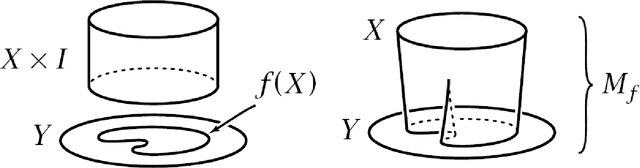
The mapping cylinder allows us to apply this description of connectivity to an arbitrary map \(e \colon Y \to Z\text{:}\) it replaces \(e\) by an inclusion followed by a homotopy equivalence.
Figure8.4.The mapping cylinder, drawn for \(f\colon X\to Y\) in place of \(e\colon Y\to Z\text{:}\) attach the end \(X\times\{1\}\) to \(Y\) along \(f\colon X\to Y\text{.}\) The remaining end \(X\times\{0\}\) is the copy of \(X\) in \(M_f\text{.}\)
There is an inclusion \(i \colon Y \hookrightarrow M_e\text{,}\)\(y \mapsto [(y, 0)]\text{,}\) and a retraction \(r \colon M_e \to Z\) sending \([(y, s)] \mapsto e(y)\) and \([z] \mapsto z\text{.}\) Linear interpolation \(\rho_t[(y, s)] = [(y, s(1-t) + t)]\text{,}\)\(\rho_t[z] = [z]\text{,}\) is a deformation retraction of \(M_e\) onto \(Z \subseteq M_e\text{,}\) constant on \(Z\text{.}\) Hence \(e = r \circ i\) factors as
Since \(r\) is a homotopy equivalence, \(e_* = r_* \circ i_*\) is a bijection (respectively surjection) on \(\pi_q\) exactly when \(i_*\) is. So \(e\) is an \(n\)-equivalence if and only if \(i \colon Y \hookrightarrow M_e\) is, which is equivalent to \((M_e, Y)\) being \(n\)-connected by the long exact sequence of the pair.