Section 16.1 Vector Bundles

Definition 16.1.

Let \(X\) be a topological space. A real vector bundle of rank \(k\) over \(X\) is a topological space \(E\) together with a surjective map \(p \colon E \to X\) such that:
  1. for each \(x \in X\text{,}\) the fibre \(E_x := p^{-1}(x)\) is endowed with the structure of a \(k\)-dimensional real vector space;
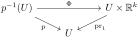
  2. for each \(x \in X\) there is a neighbourhood \(U \ni x\) and a homeomorphism (a local trivialization)
    \begin{equation*} \Phi \colon p^{-1}(U) \xrightarrow{\;\cong\;} U \times \mathbb{R}^k \end{equation*}
    making the diagram
    commute, and such that for each \(y \in U\) the restriction \(\Phi|_{E_y} \colon E_y \to \{y\} \times \mathbb{R}^k\) is an isomorphism of vector spaces.

A vector bundle is thus a fibre bundle (Definition 10.11) with fibre \(\mathbb{R}^k\text{,}\) in which each fibre is a vector space and the local trivializations identify it linearly with \(\mathbb{R}^k\text{.}\) A rank-\(1\) vector bundle is called a line bundle. Complex vector bundles (or vector bundles over any field \(\mathbf{k}\)) are defined analogously, replacing \(\mathbb{R}\) by \(\mathbb{C}\) (or \(\mathbf{k}\)).

Definition 16.2.

Let \(p \colon E \to X\) and \(p' \colon E' \to X\) be vector bundles over the same space. A vector bundle isomorphism \(E \cong E'\) is a homeomorphism over \(X\) which restricts to a vector-space isomorphism \(E_x \cong E'_x\) on each fibre.

Example 16.3.

The trivial bundle of rank \(k\) is \(\varepsilon^k := X \times \mathbb{R}^k\) with the projection \(\mathrm{pr}_1\text{.}\)

Example 16.4. Tautological line bundle.

On real projective space \(\mathbb{R}P^n\text{,}\) set
\begin{equation*} E = \bigl\{\,(\vec{x}, \ell) \in \mathbb{R}^{n+1} \times \mathbb{R}P^n \;\big|\; \vec{x} \in \ell \,\bigr\}, \end{equation*}
with projection \(p \colon E \to \mathbb{R}P^n\text{,}\) \((\vec{x}, \ell) \mapsto \ell\text{.}\) The fibre over \(\ell\) is the line \(\ell\) itself, viewed as a \(1\)-dimensional subspace of \(\mathbb{R}^{n+1}\text{.}\) This is the tautological (or canonical) line bundle over \(\mathbb{R}P^n\text{.}\) The same construction over \(\mathbb{C}P^n\) gives a complex line bundle.

Example 16.5. Tautological bundle on a Grassmannian.

Let \(\mathrm{Gr}_k(\mathbb{R}^n)\) be the Grassmannian of \(k\)-dimensional subspaces of \(\mathbb{R}^n\text{.}\) Set
\begin{equation*} E = \bigl\{\,(W, \vec{x}) \in \mathrm{Gr}_k(\mathbb{R}^n) \times \mathbb{R}^n \;\big|\; \vec{x} \in W \,\bigr\}. \end{equation*}
The projection \(p \colon E \to \mathrm{Gr}_k(\mathbb{R}^n)\) is a rank-\(k\) vector bundle whose fibre over \(W\) is the vector space \(W\) itself. A local trivialization near \(W\) is given by orthogonal projection onto \(W\text{,}\) which is an isomorphism on every \(k\)-plane close to \(W\) (Hatcher, Vector Bundles and K-Theory, Lemma 1.15). For \(k = 1\) this recovers Example 16.4, since \(\mathrm{Gr}_1(\mathbb{R}^{n+1}) = \mathbb{R}P^n\text{.}\) The complex Grassmannian \(\mathrm{Gr}_k(\mathbb{C}^n)\) carries an analogous tautological complex bundle of rank \(k\text{.}\)